Panel discussion on...
Beauty from within and holistic trends
Claire Liu
Digital Marketing Project Manager - Cosmetics & Nutrition Active ingredients, Seppic

Member of AgroFOOD Industry Hi Tech's Scientific Advisory Board

Questions
1.
2.
3.
4.
5.
6.
7.
8.
9.
10.
11.
The New Era of Beauty Claims
Where do you see the next cycle of beauty claims heading? What specific benefits are consumers searching for today, and where do you predict the market will move over the next five years? Any exciting innovations you want to share in this regard?
The intersection of GLP-1 with Hair & Skin
With the global rise of GLP-1 weight-loss medications, consumers are experiencing rapid metabolic shifts that often trigger hair loss and "Ozempic skin". How do you see the nutricosmetic segment evolving to support the intersection of beauty and weight management/metabolic health?
Holistic Beauty & The "Well-Beauty" Journey
Real beauty isn't just skin deep. What innovations are you developing to bridge beauty and wellness (e.g., neuro-beauty, mood/stress support, beauty sleep, or the gut-skin axis)? Which ingredients or concepts are currently shifting from other health categories into the nutricosmetic space?
Redefining Beauty Rituals
Topical beauty influencers have set a high bar for self-care beauty rituals—how is the nutricosmetic segment catching up? From delivery formats and flavor profiles to fragrance and texture, what is needed to evolve ingestible solutions into a truly joyful daily ritual? And where do you experience the most challenge in this respect?
The K-Beauty Influence
South Korean trends continue to redefine topical skincare. How are these K-Beauty principles being translated into the nutricosmetic industry?
Integrated "In & Out" Journeys
We are moving away from isolated products toward "integrated journeys." What evidence supports the superior efficacy of oral-topical pairings? Furthermore, how can nutricosmetics be better integrated into the dermatology space, accompanying at-home or in-clinic procedures? Is there a difference between different regions in the world?
Nutricosmetics as a Platform for Inclusivity
Skin is the most visible representation of our diversity. How do you research, develop, and market ingredients in a way that thoughtfully addresses differences in gender, ethnicity, and life stages? Any trends you are seeing or innovations you are excited about?
AI & The Feasibility of Hyper-Personalization
In the era of AI, how close are we to truly personalizing "beauty from within"? What are the greatest challenges and opportunities you see in developing ingredients and creating supplements truly tailored to an individual’s unique needs and biological data? Any other uses of AI in this space that you are excited about?
Sustainability & Clean Beauty 3.0
How is your organization addressing the demand for upcycling and "Clean Beauty 3.0"? Are there specific innovations in ingredients, technologies, or research methodologies that you believe the industry must adopt to meet the next generation of eco-conscious consumers?
The Next Phase of "Skinification"
We have seen the "skinification of hair," but where is the future of haircare headed? What "root cause" claims are consumers most seeking, and what is the next category you anticipate will undergo a similar "skinification" transformation?
Precision Solutions for Menopause
With the surge in perimenopause and menopause-specific products, how can we more accurately tailor solutions to women in these stages? What has the industry missed, and how can we better serve this demographic?
References and notes

Beauty from Within and the Rise of the “Well-Beauty” Paradigm: Towards Integrated In & Out Strategies for Healthy Longevity
3) The nutricosmetics segment is moving beyond single-targeted physical corrections to tap directly into the biological skin-mind axis. Daily emotional and environmental stressors alter inner homeostasis, generating an invisible skin hyperreactivity that accelerates aging and compromises the skin barrier. To address this "Well-Beauty" movement, botanical ingredients traditionally valued for relaxation and general well-being are successfully shifting into high-performance neuro-beauty.
Research on a specific eco-designed coriander seed oil (Coriandrum sativum, evaluated as Sepibliss™) demonstrates how traditional wellness extracts can be objectified for neuro-cosmetic applications. In vitro mechanistic trials show that this specific lipid complex exerts a cellular effect similar to traditional acupuncture conditions, reducing excessive Nitric Oxide release (a key oxidative marker triggered by emotional stress) by 56% (1) and downregulating neurosensory pain and discomfort receptors (TRPA1) in skin neural fibers by 52% (2).
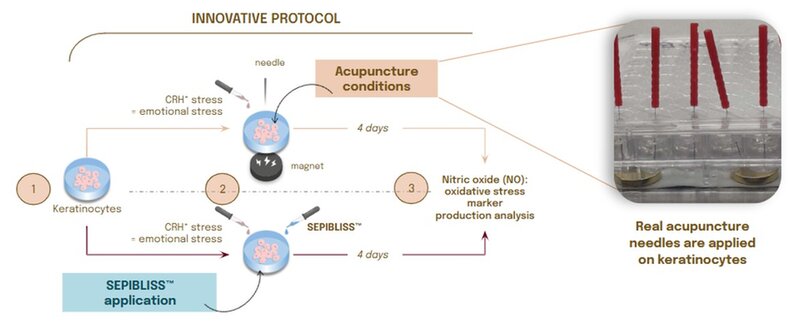
In vitro acupuncture protocol.
4) Nutricosmetics and topical skincare are fundamentally complementary, addressing beauty and wellness from entirely different entry points. While topical formulas provide localized, immediate surface care, ingestibles work systemically to support the body's internal architecture. However, to seamlessly fit alongside traditional self-care routines, the nutricosmetic segment is increasingly drawing inspiration from the sensory, playful, and experiential codes of topical cosmetics. The goal is to soften the traditionally clinical or rigid image of supplements, shifting them toward fluid, engaging daily habits without ever losing sight of scientific rigor.
This cross-pollination of sensory appeal and internal efficacy is driving the development of advanced galenic concepts, such as interactive prototype collections designed to explore how high-efficacy active ingredients behave in consumer-friendly formats.
Similarly, routine simplification can be achieved via transparent capsule-in-capsule delivery systems that isolate distinct phases within a single format. Technical protocols show that a wheat polar lipid complex extract standardized in phytoceramides can be suspended in a lipidic outer capsule to target systemic skin barrier function. Concurrently, the inner core isolates a specific probiotic complex (containing Lactobacillus plantarum PBS067, Lactobacillus reuteri PBS072, and Lactobacillus rhamnosus LRH020 administered at 3 billion CFU/day) to target the gut-skin axis (3). This physical phase separation successfully preserves the structural integrity and active potency of the viable strains over time.
The primary technical hurdle in adopting these modern, experience-driven formats lies in ensuring the physical stability and active recovery of delicate molecules during complex industrial manufacturing. Overcoming this relies heavily on selecting premium active ingredients that are inherently engineered for high formulation versatility and process resistance. When science-backed raw materials are designed with this industrial flexibility in mind, complex sensory concepts can successfully transition from a visual trend into a stable, high-efficacy commercial reality.
6) The nutrition market is increasingly opening up to new combinations to offer comprehensive, holistic programs rather than isolated products. The biological rationale behind this shift is compelling: while topical applications offer immediate, targeted care on the surface, whether protecting the skin barrier, balancing the surface ecosystem, or addressing scalp and hair care, ingestible solutions work systemically to support tissue structure and health from within.
When building a credible "In & Out" journey, the strength of the program relies on a fundamental principle: ensuring that each component of the routine is anchored in rigorous, gold-standard scientific evidence. Approaching an integrated routine as a combination of highly validated building blocks gives brands the creative and technical flexibility to design tailored programs. Pairings can be constructed around compelling concepts, such as matching botanical origins, aligned functions, or complementary biological pathways, backed by the certainty that each individual active delivers proven efficacy.
Three distinct conceptual pathways define this integration:
- A unique ingredient base for a twofold action: This approach perfectly aligns the story and biological mechanism by pairing an oral active with its corresponding topical grade. For example, oral wheat phytoceramides support the structural lipid mortar from within, while its topical counterpart (INCI: Glycosphingolipids, Glycolipids) acts directly on the surface to refine skin texture. This logic also applies to oral coriander seed oil for skin protection and soothing combined with the localized action of its neurocosmetic version (INCI: Coriandrum Sativum (Coriander) Seed Oil).
- Different ingredients for a common need: This path crosses angles of attack to solve a specific market concern. For instance, oral coriander seed oil can be paired to enhance skin comfort internally, while a topical botanical shield (INCI: Glycerin (and) Water (and) Hedychium Coronarium Root Extract) acts as a protective surface shield against the environmental stressors of the exposome.
- Thematic ingredients for complete care: This strategy unites complementary actives around a global theme or heritage story, such as pairing two ingredients both derived from biotechnology for one purpose, for instance combining a fermented wild bilberry extract with a plant cell biotech active (INCI: Crithmum Maritimum Callus Culture Filtrate) works via multi-angled biological pathways to optimize skin radiance and complexion homogeneity.
This flexible, science-backed approach adapts smoothly to regional differences in professional integration. In North America and the Asia-Pacific region, integrated journeys are largely retail-driven, focusing on preventative, lifestyle-oriented daily beauty and hair habits. In Europe, however, the integration is moving closer to the professional dermatology and medical-spa space, where aesthetic professionals recommend dual oral-topical routines to optimize skin recovery and support at-home care following in-clinic procedures.
References and notes
- Bize C., Vincent G., Kern C., Garcia C. “Acupunture-like” effect and happiness molecules: let's improve our well-being. Poster presented at 33rd IFSCC Congress, Barcelona, 4-7 September 2023.
- Kern, C., et al. OCL. 2020. 27, 49.
- Michelotti, A., Cestone, E., De Ponti, I., Giardina, S., Pisati, M., Spartà, E., & Tursi, F. (2021). Efficacy of a probiotic supplement in patients with atopic dermatitis: a randomized, double-blind, placebo-controlled clinical trial. European Journal of Dermatology, 31(2), 225-232.
Panelists

Vincenzo Zaccaria
Bionap (Active Group)
Trisha Sugarek MacDonald
Akay Bioactives, an Oterra company

Benny Antony
Arjuna Natural
Carlos Morales Ruiz
Aurora Intelligent Nutrition

Juliane Hellhammer
DAACRO

Franziska Schmitt
DAACRO



Annie Liu
DolCas Biotech
KG Rao
DolCas Biotech
Zachin Rao
DolCas Biotech

Miri Eliyahu
Euromonitor International

Magda Starula
Euromonitor International

Aarthi Janakiraman
Everest Group

Dieter Bracke
Fermedics BV

Mike Hughes
FMCG Gurus

Katia Merten-Lentz
Food Law Science and Partners

Oliver Wolf
Gelita

Silvia Pisoni
Gnosis by Lesaffre

David Foreman
Herbal Pharmacist Media

Lucilla Caricchio
Hylobates Consulting

Johanna Maukonen
IFF Health

Arthur C. Ouwehand
IFF Health

Serena Tongiani
Indena

Volker Spitzer
IQVIA Consumer Health

Stephanie Krammer-Lukas
IQVIA Consumer Health

Tyler Holstein
Kemin Human Nutrition and Health

Alison M. Winger
Key2Biotics

Karen E. Todd
Kyowa Hakko

Celia Martin
Lallemand Bio-Ingredients

Elodie Aragon
Lallemand Health Solutions

Chris Kilham
Medicine Hunter

Greg Cumberford
Natures Crops International

Pauline Cox
Sow & Arrow

Sybille Buchwald-Werner
Newday



Laetitia d’Ursel
People Science
Belinda Tan
People Science
Colleen Quinn
Colleen Quinn Consultancy


Matevž Ambrožič
PharmaLinea
Maja Orešnik
PharmaLinea


Lucia Barra
Probiotical
Annalisa Visciglia
Probiotical

Walter Fiore
ROELMI HPC

Florencia Moreno Torres
Rousselot

Shaheen Majeed
Sabinsa

Ilaria Campestri
B2B Health & Beauty,
ESG Industrial Processes Expert

Kelly Dobos
Consultant, Cosmetic Chemist

He Li
School of Food & Health
Beijing Technology & Business University

Claire Liu
Seppic

Suyin Perret-Gentil Robespierre
Suannutra

Jennifer Toomey
TopGum Industries

Inbal Nahmias
TopGum Industries

Anu Turpeinen
Valio