
Panel discussion on...
Current Developments in Food Industry and -technology
Prof. Dr. Simone Peschke
Consultant

About the Author
Prof. Dr. Simone Peschke
Emerita Professor, Consultant food technology
Main focus: Flavor technology and Innovation
Professor of Food Technology, Berlin University of Applied Sciences (10 years)
Main focus: Innovation and Product Development, Flavor Technology (in cooperation with DVAI), Functional and Novel Foods, Techno-functional Ingredients
Technical Director, Business Unit Sweet & Head of Competence Center Health & Nutrition, Symrise AG (7 years)
Senior Director Research, Development & Application Ingredients Europe, Wild Flavors Berlin (17 years)

Member of AgroFOOD Industry Hi Tech's Scientific Advisory Board

In this Panel Discussion, several prominent companies within the food and nutraceutical ingredient industry have been invited to discuss about drivers and barriers of healthy lifestyle, focusing on global and regional consumer trends, scientific achievements, emerging delivery formats, use of AI technologies and the implementation of the United Nations sustainability goals.
Commentary article
The food industry and -technology are undergoing rapid transformation, driven by public health concerns, resilience of food production, sustainability as well as by advances in digitalization and biotechnology. Currently, several megatrends are converging: smart supply chains, digital retail, and advanced food safety systems, resilient farming, sustainable ingredients, food as medicine. At the same time, debates over ultra-processed foods, clean labeling, and personalized nutrition fuel both public discourse and research investment.
This panel discussion leading experts summarizes the most relevant debates and technological advances, reflecting a diversity of geographical, regulatory, and technical viewpoints.
Commentary article
Ultra-processed foods (UPFs) remain a focal point in public health debates. While research links high UPF consumption to negative health outcomes, experts caution against simplistic classifications. The NOVA system, widely used to define UPFs, is increasingly seen as a guideline rather than a strict regulatory tool. Instead, the focus is shifting toward nutrient density, additive safety, and evidence-based risk communication.
Efforts to reduce sugar and salt are central to reformulation initiatives, with ongoing tension between regulatory compliance, cost, and consumer expectation. The challenge is complex as these ingredients affect not only taste but also structure and shelf life. New approaches include high-intensity sweeteners, polyols, dietary fibers, and mineral salt replacers, supported by AI-driven sensory modeling and digital formulation tools.
Personalized nutrition platforms integrate data from wearables, genetic tests, and microbiome profiles to generate individualized recommendations and even automate meal planning or product selection. These systems raise significant questions about data privacy, ethical design, and the risk of digital inequality.
The alternative protein sector is diversifying beyond plant-based analogs to include mycoproteins, precision fermentation, cell-cultured meat, and insect-derived products. Precision fermentation and mycoproteins are attracting significant investment due to scalability and regulatory progress, while cell-cultivated products face technological and approval hurdles. Consumer acceptance varies by region: European consumers prioritize transparency and safety, North America is more open to novel proteins, and Asia leads in regulatory innovation. The most commercially viable technologies currently are plant-based and fungal proteins, but precision fermentation and cultivated meat are advancing quickly.
Biotechnology and fermentation are enabling the upcycling of food by-products into valuable ingredients, such as collagen peptides and antioxidants. Circular economy models promote regenerative systems, integrating industrial symbiosis and localized production. Scaling these models affordably and gaining consumer trust for upcycled products remain challenges.
Technologies like vertical farming, recirculating aquaculture, and precision agriculture are making food systems more resilient and resource-efficient. Vertical farming enables year-round crop production with minimal water use, while automation improves efficiency in sorting and processing. Integration of waste streams and industrial symbiosis further reduces environmental impact. However, energy use, investment costs, and consumer engagement remain obstacles.
Artificial intelligence is revolutionizing the food sector, from logistics and production to R&D and compliance. AI systems optimize inventory, predict demand, and automate redistribution, energy saving, waste reduction and enhancing sustainability. In production processes, AI models sensory interactions and resource use, while blockchain ensures traceability and data security. Robotics and automation in primary production, sorting, and processing are providing major improvements in efficiency and scalability. Challenges persist in energy use, upfront investment, and consumer acceptance—but advancements in automation, including AI-assisted quality control and smart packaging for spoilage monitoring, are closing these gaps.
Food safety is being transformed by AI, machine learning, and blockchain. Predictive analytics enable proactive interventions, while smart management systems automate hazard detection and compliance. The rise of cellular agriculture and novel foods introduces new safety challenges, requiring updated protocols and consumer education. Regulatory environments vary: the EU maintains strict frameworks, slowing innovation, while the US and Asia are more flexible. Transparent metrics and substantiated claims are essential to maintain market trust and consumer acceptance.
Fig. 1 describes the current status of maturity of the discussed technologies, their practical industrial implementation, aligned with consumer acceptance as well as hurdles (regulatory, scale-up) of implementation.
Complementary, environmental, Social, and Governance (ESG) metrics are now integral to product development, influencing sourcing, labor, transparency, and life-cycle assessment. Companies embedding ESG into their operations and providing verifiable proof of stewardship are better positioned for future success. Cross-functional teams with expertise in food science, engineering, digitalization, and consumer psychology are needed to scale solutions responsibly.
Critical Evaluation
The food technology landscape in the following years is marked by innovation and complexity. Alternative proteins, functional ingredients, precision fermentation, and upcycling offer solutions for public health and sustainability. Digitalization is transforming supply chains, personalization, and transparency. However, challenges persist: reductionism in public discourse, scalability issues, regulatory discrepancies, uneven consumer acceptance, and high costs for new infrastructure. Regulation is both a safeguard and a bottleneck, requiring cohesive industry engagement and transparent dialogue. Personalized nutrition, while promising, introduces new inequalities and trust issues around data use.
In summary food technology is becoming more scientific and human-centered. Its direction will be shaped not only by technological opportunities but also by its ability to address real-world needs, foster trust, economical challenges and resilient food systems.
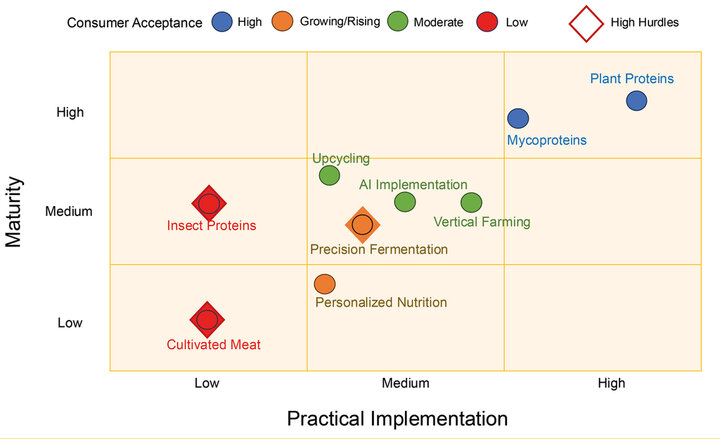
Figure 1. Status of current technological developments - Technological maturity and consumer acceptance by practical implementation (evaluated from all panel discussions, partly supported by KI-models).
Panelists

Katrin Hedvall
Head of Food Sweden AFRY


Dr. Banu Sezer
Global Market Development Manager
Anton Paar GmbH, Graz, Austria

Dr. Adam M. Adamek , PhD
CEO, Editor-in-Chief, Food Edge, Belgium

Elizabeth Koumpan
Distinguished Engineer and CTO
for IBM iOps organization

Kirt Phipps
Principal Scientific Consultant –
Toxicology & Regulatory Affairs, Intertek

Dayna Lozon
Scientific Consultant 1 – Toxicology and Regulatory Affairs, Intertek

Karen E. Todd, RD
VP, Global Brand Marketing
Kyowa Hakko USA

René Floris
Chief Innovation Officer, CIO,
NIZO Food Research

Veronika Pipan
Head of Scientific Support at PharmaLinea

Dr. Mariette Abrahams MBA
CEO & Founder of Qina
References and notes
- Arenas-Jal M, Suñé-Negre JM, Pérez-Lozano P, García-Montoya E. Trends in the food and sports nutrition industry: A review. Critical Reviews in Food Science and Nutrition. 2020;60(14):2405-21.
- Angus A. Top 10 Global Consumer Trends for 2018: Emerging Forces Shaping Consumer Behaviour: Euromonitor International; 2018 (Available from: https://tourismaccommodation.com.au/wp-content/uploads/2018/03/Top10-Global-consumer-trends-for2018.pdf.
- Labrecque LavdE, Jonas and Mathwick, Charla and Novak, Thomas and Hofacker, Charles. Consumer Power: Evolution in the Digital Age. Journal of Interactive Marketing 2013;27.
- Dunford M. Fundamentals of Sport and Exercise Nutrition 2010.
- Galaz GA. Chapter 20 - An Overview on the History of Sports Nutrition Beverages. In: Bagchi D, Nair S, Sen CK, editors. Nutrition and Enhanced Sports Performance. San Diego: Academic Press; 2013. p. 205-10.
- Bird SP. Creatine supplementation and exercise performance: a brief review. J Sports Sci Med. 2003;2(4):123-32.
- Schofield L. Vitamin Retailer The Dietary Supplement Industry Leading Magazine 2022 (Available from: https://vitaminretailer.com/activating-your-fitness-nutrition-department/.
- Newman JI, Xue H, Watanabe NM, Yan G, McLeod CM. Gaming Gone Viral: An Analysis of the Emerging Esports Narrative Economy. Communication & Sport. 2020:2167479520961036.
- Tartar JL, Kalman D, Hewlings S. A Prospective Study Evaluating the Effects of a Nutritional Supplement Intervention on Cognition, Mood States, and Mental Performance in Video Gamers. Nutrients. 2019;11(10).