FUNGI
Fermentation over fields: how fungi are solving the supply problem for natural food colors

Martin Sabatini1, Mariano di Rubbo2, Ricardo Cassini2*
*Corresponding author
1. Michroma, Rosario, Santa Fe, Argentina
2. Michroma corporation, San Francisco, California, USA

About the Authors
Martin Sabatini
Dr. Martin Sabatini (Head of R&D at Michroma) has a background in biotechnology with a decade of experience in project and product management, and strong expertise in molecular biology. He has led multidisciplinary teams, working at the intersection of biotechnology with several industries, including agriculture, health, and food. His work focuses on bridging science to business to drive innovation.
Mariano Di Rubbo
MS. Mariano Di Rubbo (Head of Regulatory & Product at Michroma) holds an engineering degree in Food Science and Technology. He has been part of Michroma’s journey from the very beginning, contributing to the process and product optimization and, more recently, to the business development and the regulatory efforts. He’s been collaborating with notable European institutions in the field of sustainable bioprocessing as part of his Master’s thesis to shine a light on the environmental foodprint of precision fermentation ingredients in comparison to those obtained through the more traditional extraction methods.
Ricky Cassini
Ricky Cassini (CEO at Michroma) is a deep-tech entrepreneur with a background in industrial management and business operations. He has led multidisciplinary teams across the U.S. and Latin America and brings a decade of experience at the intersection of sustainability, biotechnology, and food systems. Recognized by Forbes 30 Under 30 and MIT Technology Review Innovators Under 35, he has also been part of Stanford’s LBAN and the Westerwelle Young Founders program. His work focuses on scaling scientific innovation into commercially viable solutions with global impact.



KEYWORDS
Fungal fermentation
Natural colorants
Food ingredients
Supply chain
Clean label
Precision fermentation
Abstract
Natural colorants are in high demand, but their supply chains are broken. Crop-based pigments face unpredictable yields, regional sourcing constraints, and volatile pricing, challenges that only intensify as brands push to replace synthetic dyes at scale. Fermentation, particularly through engineered fungi, offers a fundamentally different path: controlled, modular, and decoupled from climate or land use. This article argues that fungal biofactories are not just a technological solution—they represent a paradigm shift in how we produce ingredients. By rethinking colorants as a product of microbial precision fermentation rather than agricultural extraction, and by outperforming legacy natural production methods on yield and consistency, the industry gains a clear path to reliable ingredient supply with significantly lower volatility. Moreover, life cycle assessments indicate that precision fermentation-derived colorants can deliver comparable color intensity with the lowest CO₂-equivalent emissions among major natural alternatives, underscoring their environmental advantage.
Introduction
The global food industry is under pressure to clean up its labels. Consumers are demanding natural alternatives to synthetic ingredients, and regulators are tightening scrutiny around additives. One of the most visible targets in this shift is food colorants. Synthetic dyes, once the go-to option for their vibrancy and cost-efficiency, are now being replaced by natural pigments extracted from plants, fruits, and vegetables. But the promise of "natural" comes with serious supply chain headaches: unstable yields, seasonal limitations, geographic constraints, weather, pests and diseases exposure, and inconsistent quality. For instance, only about 0.1% of a beet’s mass represents usable pigment, meaning 99.9% of the biomass, along with the energy and resources invested in growing it, contributes little to the final ingredient. The agricultural footprint of such production is substantial, requiring extensive land, irrigation, fertilizers, and post-harvest processing that together generate significant greenhouse gas emissions and organic waste. In contrast, microbial fermentation can produce the same color molecules in compact, controlled systems, using renewable feedstocks, less water, and minimal waste generation. From our experience, in optimized processes, pigments can account for more than half of the total biomass produced, representing a step-change in conversion efficiency compared with crop-based extraction. This shift not only stabilizes supply but also offers a measurable reduction in environmental impact through more efficient use of carbon, energy, and natural resources.
The natural food colorants market is on a sharp upward trajectory, expected to grow from USD 2.03 billion in 2025 to USD 2.92 billion by 2030, with a CAGR of 7.54 %, according to Mordor Intelligence (1). However, this projection does not yet account for the impact of the phase-out of synthetic dyes in the U.S., a regulatory shift that is already influencing global markets and triggering reformulations across major food brands. As more countries follow suit, this trend could redirect demand equivalent to 10 times the current synthetic dye market toward natural alternatives. Yet replacing synthetics is no simple swap; these petrochemical-based dyes are ultra-concentrated, thermally stable, and cost-effective, often requiring only a fraction of the dosage needed for natural colorants to achieve similar visual impact. Most natural dyes are less potent, less stable, and more expensive, meaning the volume required to meet global demand will increase dramatically. This volume burden exposes the weaknesses of crop-based sourcing: geographic limitations, seasonal variability, and unsustainable production practices. In this context, microbial fermentation becomes not just competitive, but essential. It enables scalable, consistent, and climate-independent pigment manufacturing that can fill the growing demand gap created by both regulation and consumer pressure.
The Cracks in the Crop-Based Supply Chain
Natural colorants sourced from crops face challenges that are systemic, not incidental. Agricultural variability due to climate change, pests, or geopolitical disruption can throw off entire production cycles. Even when crops are successfully harvested, extraction and purification processes are labor-intensive, water-heavy, and yield-limited; this makes it hard to scale or standardize supply. Seasonal and regional dependencies further constrain supply, while storage and transportation of delicate pigments require careful handling to prevent degradation. These technical and logistical hurdles make it challenging to reliably scale production, meet rising global demand, and maintain consistent quality, highlighting inherent vulnerabilities in traditional crop-based supply chains. (2).
Also, the overreliance on pigment crops creates a cascade of secondary costs: increased cold chain logistics, higher rates of waste due to inconsistent raw materials, and inflated pricing caused by fragmented supply networks. Many natural colorant producers are forced to source across continents just to meet volume requirements, introducing inefficiencies that strain both profitability and sustainability. These inefficiencies are baked into the system, not bugs to be fixed.
Nature’s Most Powerful Biofactories
Fungi are emerging as powerful biological factories capable of producing a diverse array of high-value ingredients, ranging from pharmaceuticals and nutraceuticals to food additives and biomaterials. For instance, medicines such as penicillin from Penicillium rubens, used in antibiosis; and statins, from Aspergillus terreus, in cholesterol management. Another relevant examples, Aspergillus niger is responsible for producing around 95% of the world’s citric acid, a cornerstone compound in food preservation, pharmaceuticals, and cosmetics; fusarium venenatum is harnessed to create mycoprotein, a sustainable, protein-rich meat alternative (3); Monascus purpureus has long been used in Asia to produce red pigments such as monascorubrin and rubropunctatin for coloring food and cosmetic (4). Fungi also produce valuable enzymes, such as amylases, lipases, and proteases, widely used in food processing (5). Finally, filamentous fungi can ferment agricultural residues to yield antioxidants, natural pigments, polysaccharides, and organic acids, all through valorization of waste streams into high-value compounds (6).
Fermentation : Nature reimagined through fermentation
Fermentation flips this equation. Increasingly backed by industrial investment and R&D momentum, precision fermentation is enabling a new tier of supply chain autonomy. Moreover, combining the metabolic plasticity of fungi and synthetic biology, the opportunities can grow exponentially. By engineering fungal strains to biosynthesize specific color molecules, producers can bypass the field entirely. Grown in controlled bioreactors, these fungi produce target compounds with high yield, batch-to-batch consistency, and minimal land or water use. More importantly, fermentation decouples ingredient manufacturing from traditional agricultural cycles and geographical constraints.
Additional advantages include the flexibility to scale production up or down in response to demand fluctuations, and enhanced sustainability: fermentation reduces the need for pesticides, conserves land and water, lowers greenhouse gas emissions, and can utilize inexpensive or waste feedstocks, promoting more sustainable practices and enabling a circular economy (7).
Of course, novelty without safety is meaningless if consumer health is not safeguarded. These new molecules hold tremendous potential, but they are subject to rigorous evaluation before reaching the market. The most important regulatory bodies that set the conditions, legislate, and oversee the approval and standardization of food additives in the world are EFSA, the European Food Safety Authority, in the European Union (EU), and the FDA, Food and Drug Administration, in the United States (U.S.). Also, JECFA, the Joint Expert Committee on Food Additives of the Food and Agriculture Organization (FAO)/World Health Organization (WHO), and the Codex Alimentarius are key regulatory bodies that usually require comprehensive toxicological, chemical, and manufacturing data to demonstrate safety under intended use conditions. The main risk typically associated with fungi lies in their potential to produce mycotoxins or allergenic compounds; therefore, only well-characterized, non-toxigenic strains are selected for industrial applications. Even with high-purity substances, extensive toxicological testing remains essential to ensure that population exposure levels are several orders of magnitude below any threshold of concern. Finally, clear labeling, transparent documentation, and regulatory compliance are key to fostering both consumer confidence and market acceptance of these next-generation fungal-derived colorants (2).
Solving for Cost, Scale, and Consistency
One of the key bottlenecks for natural colorants is cost. Plant-based colors often require vast inputs for minimal output. Fungal fermentation, on the other hand, can be optimized at both the genetic and process level to boost productivity and reduce costs per gram. Because production conditions are fully controlled, output is resilient to external shocks and benefits from accelerated improvement cycles, allowing producers to iterate, optimize, and scale more rapidly than agricultural inputs ever could. This makes it possible to meet industrial demand with reliable supply and predictable pricing (8).
Still, microbial pigment production faces significant economic challenges. Fermentation requires expensive infrastructure, sterile conditions, and energy-intensive downstream processing, while microbial growth media can add substantially to operating costs. Moreover, current scale-up limitations restrict cost competitiveness with synthetic pigments, slowing wider industrial adoption.
Looking forward, several strategies offer promise for cost reduction. The use of low-cost agro-industrial residues as substrates, combined with advances in metabolic engineering and synthetic biology, can enhance yields and reduce input expenses. At the same time, the establishment of larger, more efficient fermentation facilities will allow economies of scale to drive down unit costs. Taken together, these advances are expected to make fermentation-based colorants increasingly competitive, offering a more sustainable and resilient alternative to agriculture-dependent sources (9)
Beyond Ingredient Supply: Strategic Implications
The shift to microbial manufacturing isn’t just about fixing a broken supply chain, it’s about transforming the business model. With fermentation, companies can bring production closer to the point of use, support regional manufacturing independence, and significantly reduce environmental impact through localized, low-footprint operations. This opens doors not just for cost savings, but also for rapid innovation and regulatory agility. Moreover, fermentation ensures consistent product quality across batches and allows for rapid scaling to meet fluctuating demand, further strengthening the business model by attracting food manufacturers.
Life cycle assessment of precision fermentation-derived ingredients
While many of the natural colorants currently available in the market rely on agricultural land to grow the vegetables from which the colorants are extracted through energy-intensive processing steps, precision fermentation arises as an attractive alternative to obtain high-yield and high-purity ingredients using fewer resources. For example, Michroma produces RED+, a highly stable colorant produced by fungal fermentation. To determine quantitatively how much less, we conducted an ISO-validated standardized Life Cycle Assessment (LCA) (10). Using this methodology, the impact of a product was assessed throughout its entire life cycle, from raw material extraction to end-of-life. In line with a recent study published in Nature (11), which evaluated the environmental performance of a modified baker’s yeast producing the same coloring compound normally extracted from red beet (betanin), we also found the bioprocess to be more sustainable in terms of land and energy usage than its traditional extraction counterpart. To extend this approach to novel coloring substances, both coloring power and production yield must be taken into account, and, as only the highest-performing strains and molecules are targeted, our preliminary results are showing very promising outcomes for the new natural fungal-based alternatives as well (Figure 1 ).
As illustrated in Figure 1, the Red+ fermentation process shows lower climate change impact (0.20–0.36 kg CO₂ eq.) compared to both beetroot (1.23–10.56 kg CO₂ eq.) and carmine (0.57–0.92 kg CO₂ eq.) production. This reduction highlights the efficiency of microbial systems, in this particular case, filamentous fungi, in turning simple substrates into pigments with lower environmental burden. Fungal-based systems such as those used for Red+ eliminate the need for agricultural land use and reduce downstream processing demands, further lowering emissions. These findings reinforce the potential of precision fermentation as a transformative approach to producing sustainable, high-performance colorants at industrial scale
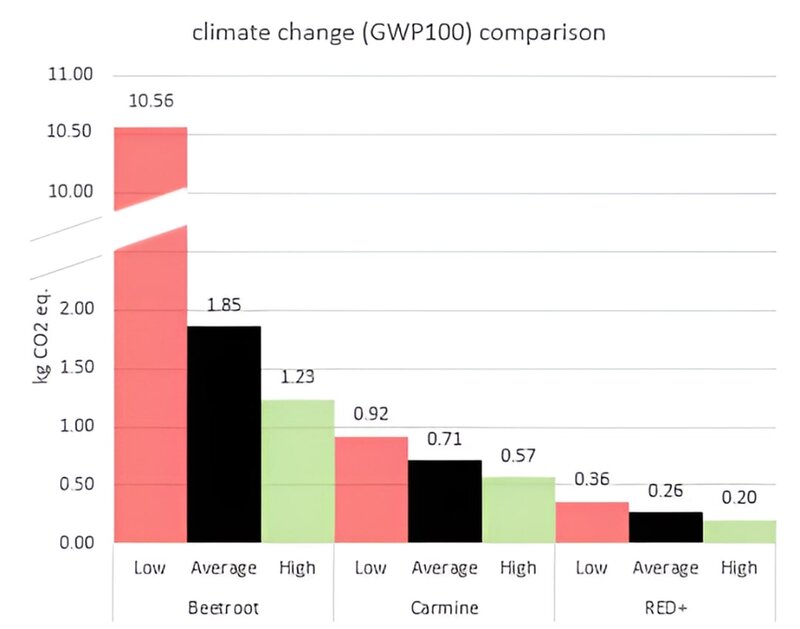
Figure 1. This graph compares the carbon dioxide equivalent emissions (kg CO2 eq.) for three different red colorants: beetroot, carmine, and Michroma’s RED+. The emissions are shown for three scenarios: low, average, and high yield. For this life cycle assessment, the functional unit was defined as the kilograms of each of these colorants needed to take 100 kg of a soft beverage to the same final absorbance of 1 a.u, and the environmental performance in terms of carbon dioxide equivalent emission favors the precision fermentation-based solution in all the scenarios analyzed. These insights are part of an unpublished study that used internal data supported by the OpenLCA database.
A brief summary of key features comparing crop-based pigments and fungal fermentation-derived pigments is shown in table 1.
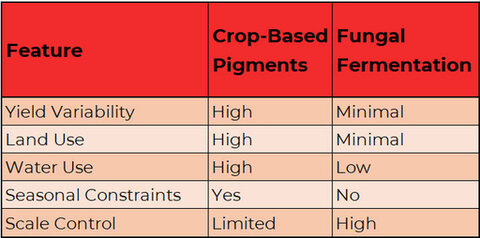
Table 1. Comparison of key environmental features evaluated during life cycle assessment between crop-based pigments and fermentation-derived.
Conclusion
Fungi are often associated with decay, but in the case of food colorants, they may represent a rebirth. Through precision fermentation, the food industry can leap past the limitations of crop-based pigment sourcing and build a resilient, scalable future for natural ingredients, one where fungi could become foundational infrastructure in the global ingredient economy over the next decade. As technology matures, fermentation can lower production costs through higher yields, faster cycles, and economies of scale, making bio-based ingredients competitive with synthetic ones and accelerating the adoption of these new technologies. In harnessing the transformative power of fungi, we are not merely producing ingredients; we are rewriting the rules of food innovation, turning microscopic organisms into architects of a vibrant, sustainable, and limitless future.
Given the current regulatory landscape, pushing synthetic dyes away from our foods will take time, but biotechnology is poised to gain ground as crop-based colorants face several limitations discussed throughout this article. During this transition, we will witness a revolution in the natural color markets: prices will probably fluctuate before a new equilibrium is reached. Yet this new stability will depend on how successfully new technologies can deliver pigments at scale and at competitive costs. Regulatory clearance, consumer perception, and manufacturing capacity will be decisive factors that determine which technologies will dominate the market. While we think biotech-derived pigments becoming the dominant source in the long term, their adoption will likely be heterogenous across regions and applications. Some of today’s natural pigments may disappear due to their constraints, but this shift will ultimately position biotechnology not only as a sustainable alternative, but as a strategic driver redefining how the industry balances performance, cost, and environmental impact.

References and notes
- Natural Food Colorants Market Size & Share Analysis - Growth Trends & Forecasts (2025 - 2030)https://www.mordorintelligence.com/industry-reports/global-natural-food-colorants-market
- Novais C, et al. Natural Food Colorants and Preservatives: A Review, a Demand, and a Challenge. Journal of agricultural and food chemistry[JVB1] . 2022, 70 (9), 2789-2805 Doi: 10.1021/acs.jafc.1c07533
- Roth MG, Westrick NM, Baldwin TT. Fungal biotechnology: From yesterday to tomorrow. Front Fungal Biol. 2023;4:1135263. Doi: 10.3389/ffunb.2023.1135263
- Egea MB, et al. The potential, strategies, and challenges of Monascus pigment for food application. Frontiers in sustainable food systems. 2023, 7:1141644. Doi: 10.3389/fsufs.2023.1141644
- Corbu VM, et al. Current insights in fungal importance—A comprehensive review. Microorganisms. 2023;11(6):1384. Doi: 10.3390/microorganisms11061384
- Turchetti B. Biotechnological applications of fungi for a healthier future. Fungal genomics and biology. 2024; volume 14, issue 3. Doi: 10.35248/2165-8056.24.14.253
- Augustin MA, Hartley CJ, Maloney G, Tyndall S. Innovation in precision fermentation for food ingredients. Critical reviews in food science and nutrition. 2024; 64(18):6218. Doi: 10.1080/10408398.2023.2166014
- Di Salvo E, et al. Natural pigments production and their application in food, health and other industries. 2023; 15(8):1923. Doi: 10.3390/nu15081923
- Oliveira Barreto JV, et al. Microbial Pigments: Major Groups and Industrial Applications. Microorganisms. 2023; 11(12):2920 Doi: 10.3390/microorganisms11122920
- International Organization for Standardization (2006) ISO 14040:2006: Environmental management - Life cycle assessment - Principles and framework. Retrieved on 16 July 2025 from https://www.iso.org/standard/37456.html[MS2]
- Thomsen, PT et al. Beet red food colourant can be produced more sustainably with engineered Yarrowia lipolytica. Nature Microbiology. 2023, 8, 2290–2303. Doi: 10.1038/s41564-023-01517-5.
