
Panel discussion on...
ESG & Strategic Partnerships in Pharma Supply Chain


Dr. Kerstin Stangier
Head of Corporate Development, Governance & Sustainability, BioSpring


Where Sustainability Meets GMP Excellence: Driving the Future of Oligonucleotide Manufacturing
For CDMOs working in therapeutic oligonucleotides, ESG is becoming more relevant, although the public debate may have become less visible in parts of the world.
As a supplier to biotech and pharmaceutical companies, we observe that ESG is becoming increasingly important, especially for larger organizations. Consequently, expectations regarding ESG performance and transparency across the supply chain are becoming more specific.
At the same time, meeting ESG expectations should be understood as part of a broader strategy to enhance long-term resilience, competitiveness, and stakeholder trust, rather than as a standalone objective. Recent global crises and increasing volatility have shown how closely sustainability and resilience are connected. Reducing energy and resource consumption, lowering dependency on critical inputs and strengthening supplier governance can also make supply chains more robust. In our industry, however, where patient safety is the ultimate objective, ESG must connect with how processes are developed, scaled, qualified, supplied and improved over time.
This operational connection is particularly important for oligonucleotide APIs. Solid-phase phosphoramidite chemistry has enabled an important class of medicines, including ASOs, siRNAs, guide RNAs and other nucleic acid-based modalities. These therapeutic advances, however, rely on a resource-intensive manufacturing process. Solvents, reagents, purification, water consumption, waste streams and scale-up complexity all become more relevant as programs move from early development into clinical and commercial supply. A process that uses resources more efficiently and economically avoids unnecessary waste and can be scaled in a controlled way.
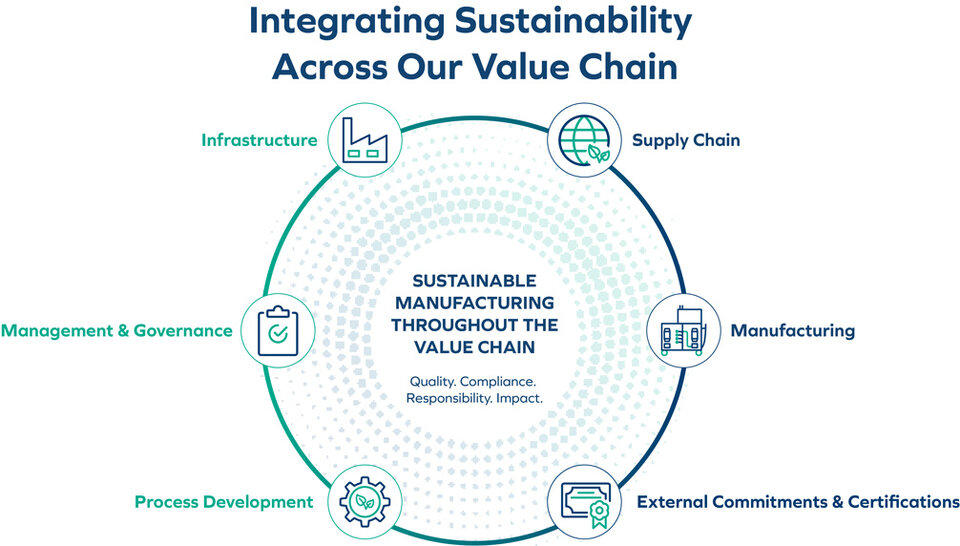
At BioSpring, we look at ESG primarily through this operational lens. Our first responsibility is to provide high-quality nucleic acid APIs in a reliable and compliant manner. GMP compliance and product quality form the foundation of any framework to improve environmental and supply-chain-related aspects.
Energy and resource efficiency illustrate this approach well. BioSpring operates an energy management system aligned with ISO 50001 and continuously improves its energy performance through a combination of strategic initiatives and operational measures. We regularly inspect all cooling systems for refrigerant leaks to minimize energy losses and prevent emissions. Where feasible, we replace environmentally harmful refrigerants with more environmentally friendly alternatives to improve sustainability and reduce environmental impact.
Beyond energy efficiency, we apply the same sustainability principles to materials and waste. In regulated pharmaceutical manufacturing, resource efficiency must be balanced with contamination control and process robustness. Where feasible, extending equipment lifetime, refurbishing components, reducing avoidable material consumption and using solvent recycling already lower environmental impact while supporting stable operations.
We strive to reduce the use of single-use materials by introducing more sustainable alternatives whenever possible. Any replacement is carefully assessed to ensure full compliance with GMP requirements and product quality standards.
Significant opportunities to reduce the environmental impact of oligonucleotide production can often be realized through process development. Decisions around necessary solvents, purification strategies, and quality and yields strongly influence the environmental profile of a program. We believe that sustainable process development starts with technical decisions that reduce resource intensity while maintaining or improving impurity control and overall process performance.
We have successfully developed a new synthesis process using an alternative solvent with a lower environmental impact. Its implementation in production is now beginning, marking an important step towards more sustainable manufacturing while maintaining the required quality and regulatory standards.
Digitalization is a prerequisite for effective ESG management. In a GMP environment, success depends on reliable, structured and auditable data. BioSpring's digital environmental and ESG management systems help transform operational data into actionable insights that support transparency, performance monitoring and informed decision-making. This is the basis for internal evaluations, customer questionnaires, supplier assessments and future reporting requirements.
Supplier selection is increasingly influenced by ESG criteria, as sustainability becomes a key consideration in procurement decisions. CDMOs are increasingly asked to provide assurance not only on their own operations, but also on the upstream supply chain: raw materials, critical suppliers, logistics, documentation, business continuity and, increasingly, environmental and social criteria. BioSpring integrates ESG criteria into its Supplier Code of Conduct and purchasing guidelines, including considerations such as the sustainability and carbon footprint of purchased products, as supplier selection in pharmaceutical manufacturing cannot be based on price and availability alone. For critical materials, technical quality, continuity of supply, responsible procurement and ESG-related transparency must be evaluated together.
Our sustainability efforts are supported by our ISO 50001-certified energy management system, our EcoVadis and CDP assessments, and our commitment to the Science Based Targets initiative (SBTi) Near-Term Target. We seek to work with suppliers who share our commitment to sustainability and encourage them to implement comparable environmental and climate initiatives.
The supplier perspective highlights the close connection between ESG and resilience. Climate events and geopolitical tensions causing supply chain disruptions and trade conflicts, as well as regulatory changes can all affect critical materials. Supplier risk management therefore has to consider both sustainability and supply security. Updated risk management, additional KPIs, supplier mapping, and qualification of additional suppliers can help reduce dependencies and improve transparency.
Resilience and ESG are most effective when they are addressed together. By integrating ESG considerations into risk management and business continuity planning, companies strengthen both supply security and long-term sustainability. This enables BioSpring to maintain reliable delivery to customers and, ultimately, to patients, while upholding its ESG commitments even under challenging conditions.
Looking toward 2030 and beyond, technical expertise, GMP compliance and reliable manufacturing capacity will remain essential. Equally, CDMOs will be expected to provide credible ESG data, understand the sustainability impact of process and supply-chain decisions, support their customers' decarbonization goals, and contribute to more resource-efficient manufacturing.
For oligonucleotide therapeutics, this will be especially important as the field matures and more programs move toward larger clinical and commercial volumes. At BioSpring, ESG is an integral part of how we develop processes, manufacture oligonucleotides, and work with our partners, always with patient safety as our highest priority.
Panelists

Blake Unterreiner
Vice President and Business Unit Leader, Agilent Advanced Therapeutics


Michael Rainey
Director of Supply Chain, Almac Sciences

Françoise Durand-Rivoire
Global Head of ESG, Axplora

Hans van Hees
COO of Bachem AG

Matthias Müllner
CEO and co-founder of bespark*bio
Kerstin Stangier
Head of Corporate Development, Governance & Sustainability, BioSpring

Yann Dherve
Chief Executive Officer - CDMO, Cohance Lifesciences

Roger La Force
Managing Director, Dorra Pharma Group

Joanne Flinn
Chair, The ESG Institute


Xavier Touche1, Alain Goasguen2
1. Global Head of Supply Chain at Euroapi
2. Head of Environment & Energy at Euroapi

Anne Lise Kopp
Corporate ESG & Transformation Leader, Flamma Group

Robert Dream
Managing Director, HDR COMPANY LLC

Nathalie Huther
Chief Commercial Officer, HFR

Justin Mason-Home, FRSC
Owner/Director, HPAPI Project Services Limited

Patrizia Fazio
Head of applied research coordination, Imprima

Laura Monti
Responsible Sourcing - Purchasing department, Indena

Stanislav Kazanov
Head of GRC, Cybersecurity & Sustainability, Innowise

Sonja Merkas
Founder and CEO, Livinovea

Verena Buback
Head of Sustainability Strategy, Merck Procurement

Dirk Kirschneck
Strategic Director,
Microinnova Engineering GmbH

Saharsh Davuluri
CEO & Managing Director, Neuland Laboratories

Tammy Cooper
President, Nitto Avecia and
Nitto Avecia Pharma Services



Shaojun Zhu1, Dongxin Zhang2, David Ennis3
1. Director of Sustainability Development, PharmaBlock
2. Executive Director and Head of Business for New Modalities, PharmaBlock
3. Executive Advisor, PharmaBlock

Peter DeYoung
CEO, Piramal Global Pharma


Sonia Rasi1, Michele Tappa2
1. Financial Director & Chief Sustainability Officer, Procos
2. ESG Manager, Procos

Pascal Villemagne
CEO, Seqens

Darryl Ratty
Executive Director, Global ESG, SK pharmteco


Natalia Agüeros1, Ralf Karch2
1. Sr. Director, ESG & Sustainability, Umicore
2. Director BU Research & Development at PMC, Umicore

Dani Reguant
Supply Chain Director, Uquifa Group
References and notes
- Howes, M.J.R., Simmonds, M.S.J. and Kite, G.C. (2004) 'Evaluation of the quality of sandalwood essential oils by gas chromatography–mass spectrometry', Journal of Chromatography A, 1028(2), pp. 307-312. doi: 10.1016/j.chroma.2003.11.093.
- RTI Health, Social, and Economics Research (2002) 'The Economic Impacts of Inadequate Infrastructure for Software Testing', Report prepared for the National Institute of Standards and Technology (NIST), Gaithersburg, MD.