PEER REVIEWED
Weight management
Weight Regulation Through a Metabolic Lens: Postprandial Glucose, Insulin Dynamics, and Botanical Strategies

Dr Preeti H. Jethwa PhD¹ , Dr Lisa C. Offringa PhD² , Michael J. Lane³ , Andrew Gallagher⁴
1. Scientific Affairs EMEA, Phynova, United Kingdom
2. Scientific Affairs US, Phynova, United Kingdom
3. Science Operations Specialist, North America, Phynova, United Kingdom
4. Head of Global Science, Phynova, United Kingdom
About the Authors
Preeti H Jethwa
Dr. Preeti H Jethwa is Scientific Affairs Manager at Phynova, specialising in metabolic health and nutrition. She holds a PhD in Neuroendocrinology from Imperial College London and is a Fellow of the Royal Society of Biology. Following a distinguished academic career in metabolic physiology, she now leads translational science and evidence generation for novel nutritional ingredients such as Reducose®, bridging mechanistic research, clinical trials and regulatory requirements to advance evidence-based health solutions.
Lisa Offringa
Dr. Lisa Offringa is a medical and nutritional ethnobotanist specialising in plant-derived ingredients, with over 20 years of experience translating botanical science from field to market. She earned her PhD from The New York Botanical Garden and CUNY and completed postdoctoral research in Nutrition at Stanford University’s School of Medicine. She is the scientific and regulatory expert for customers across the Americas, where she builds the human clinical evidence base behind Reducose® and develops the materials that support and accelerate its growth.
Michael Lane
Michael Lane leads the strategic scientific projects supporting Reducose®, including research, clinical trials and scientific partnerships. Michael holds a master’s degree in chemistry from the University of Oxford and an MBA from the University of Warwick. With a background in life-science strategy, he helps create novel propositions and develop market-focused combinations to advance plant-derived health solutions globally.
Andrew Gallagher
Andrew Gallagher is Global Head of Science at Phynova and a scientific and commercial leader with over 20 years of experience in natural-product research and evidence-based health ingredients. He holds an MSc in Biology, an MBA with distinction and is completing a PhD in Health Economics. His expertise spans discovery science, preclinical and clinical research, intellectual property and regulatory strategy. He has played a central role in developing and scientifically validating innovative nutritional ingredients, helping translate research into commercial health solutions.




KEYWORDS
Mulberry leaf extract (MLE)
Insulin
Postprandial glucose
Weight management
Abstract
Postprandial glucose and insulin dynamics are central to appetite regulation, substrate utilisation and long-term bodyweight trajectories. Rapid glycaemic excursions trigger reactive hyperinsulinaemia, suppress fat oxidation and alter gut–brain signalling pathways that influence hunger, satiety and energy intake. Repeated exposure to these fluctuations contributes to glycaemic variability, reduced metabolic flexibility and increased susceptibility to weight gain. This review examines mechanistic pathways linking postprandial glucose handling to adiposity, highlighting evidence from cellular, animal and human studies showing that moderating carbohydrate digestion can reduce postprandial glucose and insulin exposure and stabilise appetite‑related hormonal responses. Building on this evidence, a patented mulberry leaf (Morus alba) extract enriched with iminosugars, is evaluated as a nutritional strategy for supporting healthier postprandial metabolism and weight regulation.
Introduction
Weight regulation is increasingly understood as the product of interacting metabolic, neuroendocrine and behavioural pathways that are highly conserved across mammalian species and function collectively to maintain stable energy reserves (1). A central component of this regulatory network is glucose handling after meal ingestion. Postprandial glucose (PPG) excursions act as a primary metabolic signal, coordinating communication between the gastrointestinal tract, the central nervous system and adipose tissue (2). When glucose enters the circulation rapidly, pancreatic β‑cells generate a proportionally large insulin response, engaging G‑protein‑coupled receptor pathways and downstream metabolic processes that influence substrate use, energy availability and appetite regulation (3). Over time, repeated exposure to exaggerated glycaemic and insulinemic responses contributes to metabolic inflexibility, heightened hunger drive and progressive adiposity (4). Together, these processes highlight the importance of moderating PPG dynamics; however, achieving this consistently through dietary modification alone is challenging in modern food environments(5). Even structured interventions such as low‑carbohydrate, ketogenic or time‑restricted eating often fail due to behavioural, environmental and physiological pressures (6).
The recent clinical success of glucagon‑like peptide‑1 receptor agonists (GLP‑1 RAs), which influence PPG handling alongside delayed gastric emptying and central appetite regulation, underscores the importance of glucose–insulin dynamics within broader weight‑regulatory pathways. GLP1-RA reduce energy intake through delayed gastric emptying, and direct central appetite‑regulatory effects while also enhancing glucose‑dependent insulin secretion (7). In parallel, rising public awareness of metabolic health has created new opportunities, with consumers increasingly seeking accessible, nutrition‑based approaches that complement medical therapies. This has intensified interest in interventions that attenuate PPG excursions in ways compatible with real‑world eating patterns. Among these, botanical modulators of carbohydrate digestion, such as mulberry leaf extract (MLE), have increasing interest because its iminosugar constituents can competitively inhibit intestinal α-glucosidase, thereby slowing carbohydrate digestion and reducing the rate of postprandial glucose appearance.
This review synthesises mechanistic, clinical and behavioural evidence linking postprandial glucose–insulin dynamics to weight regulation and evaluates the role of MLE as a botanical strategy for moderating postprandial carbohydrate handling.

Postprandial Glucose and Insulin Dynamics in Weight Regulation
Post‑meal glucose handling exerts immediate and downstream effects on appetite, energy stability and substrate utilisation. Rapid glucose absorption stimulates a steep insulin response, which, while essential for glucose clearance, simultaneously suppresses lipolysis, inhibits fatty‑acid oxidation and promotes nutrient storage across hepatic, muscular and adipose compartments. Insulin acts as the master regulator of postprandial metabolism, coordinating glucose uptake, hepatic glucose production, adipose tissue lipolysis and protein turnover (8). These metabolic effects are tightly coupled to neuroendocrine pathways. Glycaemic excursions modulate secretion of GLP‑1, glucose‑dependent insulinotropic polypeptide (GIP), peptide YY (PYY) and ghrelin, altering hypothalamic and mesolimbic circuits that govern hunger, reward and satiety (7). When glucose rises sharply and falls rapidly, these hormonal oscillations amplify hunger and drive compensatory eating. Leptin–GLP‑1 interactions further modulate these responses, with leptin resistance attenuating GLP‑1‑mediated hypophagia (9). These mechanisms align with broader neurobiological models of weight regulation (1).
Inter‑individual variability in postprandial responses is substantial. Studies integrating continuous glucose monitoring (CGM) with microbiome profiling demonstrate that gut microbial composition is a major determinant of glycaemic variability, influencing both glucose absorption and insulin sensitivity (10). Machine‑learning models further show that personalised glycaemic responses predict weight‑gain susceptibility and can be used to tailor personalised dietary interventions (11). Stabilising PPG is not merely a glycaemic objective, it is a behavioural and metabolic objective, reducing hunger, improving energy stability and supporting fat loss.
Mechanistic Pathways Linking Glycaemic Spikes to Adiposity
Postprandial glycaemic spikes influence adiposity through interconnected metabolic and neuroendocrine pathways (Figure 1).
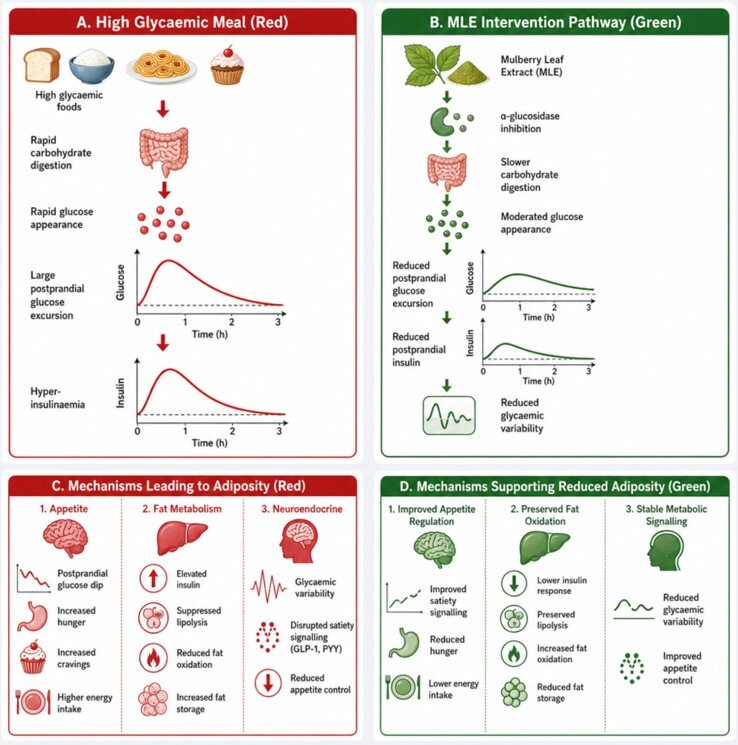
Figure 1. Pathways linking postprandial glucose regulation to adiposity and the modulatory effects of mulberry leaf extract (MLE). (A) High‑glycaemic foods drive rapid carbohydrate digestion, steep postprandial glucose excursions and proportionally large insulin responses. (B) MLE inhibits intestinal α‑glucosidase, slowing carbohydrate digestion and moderating postprandial glucose and insulin dynamics. (C) Glycaemic variability contributes to increased hunger, reduced fat oxidation and impaired satiety signalling, promoting positive energy balance and adiposity. (D) Moderating glycaemic variability may improve appetite regulation, preserve fat oxidation and support healthier body composition.
Rapid insulin rises suppress hormone‑sensitive lipase, reduce fatty‑acid mobilisation, and inhibit mitochondrial β-oxidation; repeated postprandial hyperinsulinaemia progressively biases substrate use toward carbohydrate oxidation at the expense of fat utilisation, creating metabolic inflexibility (12). At the hepatic level, rapid glucose appearance accelerates glycogen synthesis but simultaneously stimulates de novo lipogenesis, promoting hepatic steatosis and visceral fat accumulation. These effects are amplified by the entero‑insular axis with exaggerated GLP‑1 and GIP secretion that intensifies insulin exposure and further suppresses fat oxidation, reinforcing a storage‑dominant metabolic state. The magnitude of these responses is shaped by gut‑derived factors, including gastric emptying rate, intestinal glucose transporters (SGLT1, GLUT2) and incretin secretion, all of which determine the speed and amplitude of postprandial glycaemia (7).
Beyond these host‑driven mechanisms, the microbial ecosystem strongly influences postprandial glycaemia. Microbial metabolites such as short‑chain fatty acids regulate intestinal glucose absorption by modulating SGLT1 and GLUT2 expression, while also enhancing hepatic and peripheral insulin sensitivity through G-protein-coupled receptor (GPCR)‑mediated pathways, a major signalling family involved in metabolic regulation.
Dysbiosis increases intestinal permeability and low‑grade inflammation, impairing insulin action and amplifying the glycaemic response to identical meals. Microbial composition also shapes bile‑acid pools, which regulate GLP‑1 secretion via G protein-coupled bile acid receptor 1 (TGR5) and farnesoid X receptor(FXR) signalling, thereby altering the incretin response and downstream insulin dynamics. Together, these microbe–host interactions determine both the height of glycaemic excursions and the metabolic fate of absorbed nutrients, linking microbiome structure directly to adiposity risk (10).
Glycaemic Variability, Appetite Regulation and Long-Term Weight Gain.
Weight gain requires sustained positive energy balance, but the physiological mechanisms shaping energy intake are more closely tied to postprandial metabolism than is often appreciated. Beyond their role in glucose homeostasis, PPG and postprandial insulin (PPI) excursions influence appetite regulation, food reward, energy stability and subsequent eating behaviour (7).
After consuming rapidly digestible carbohydrates, blood glucose rises sharply, eliciting a proportionally large insulin response. Although this response is necessary for glucose disposal, the resulting decline in circulating glucose can, in some individuals, lead to a postprandial glucose dip below baseline levels. Emerging evidence suggests that these glucose dips are associated with increased hunger, earlier initiation of subsequent meals and greater energy intake over the remainder of the day (13). Analysis of over 1,000 participants in the PREDICT study demonstrated that larger postprandial glucose declines were associated with significantly increased hunger and greater caloric consumption, independent of meal composition (13).
These findings provide a mechanistic framework linking glycaemic variability to weight gain. PPG excursions are associated with appetite dysregulation and may contribute to behavioural patterns that favour weight gain. Repeated cycles of rapid glucose excursions followed by exaggerated insulin responses and subsequent glucose declines may promote compensatory eating behaviours, increase daily energy intake and contribute to positive energy balance. Studies also show substantial inter-individual variability in postprandial glycaemic responses, influenced by insulin sensitivity, meal composition, gastric emptying, and gut microbiota composition (10, 11). Individuals exhibiting greater glycaemic variability may therefore be particularly susceptible to appetite dysregulation and weight gain.
Importantly, longitudinal evidence suggests that disturbances in postprandial glucose and insulin handling may precede the development of obesity-related metabolic dysfunction. In a four-year prospective study, individuals who gained weight demonstrated progressive increases in energy intake, fasting insulin concentrations and insulin resistance, whereas weight-stable individuals maintained greater metabolic stability and dietary quality (5). These findings suggest that repeated exposure to exaggerated PPI responses may contribute to the behavioural and metabolic adaptations that favour long-term weight gain. Collectively, these data support the concept that controlling the rate of glucose appearance following meals represents not only a strategy for improving glycaemic outcomes but also a means of influencing appetite regulation, energy intake and body-weight trajectories.
Targeting Postprandial Glucose as a Lever for Weight Management
The links between glycaemic variability, appetite, and weight-gain susceptibility make PPG a clear intervention target. By slowing the rate of glucose appearance and reducing insulin demand, interventions targeting postprandial metabolism may help preserve fat oxidation, improve metabolic flexibility and support appetite control (13).
A variety of nutritional approaches have been investigated to achieve this objective. Gut-based strategies, including delayed gastric emptying, inhibition of a-glucosidase activity and modulation of intestinal glucose transport, have all been shown to reduce postprandial glycaemia (1). While dietary carbohydrate restriction can achieve similar effects, long-term adherence is often challenging in free-living populations (6, 14). Interventions that moderate glucose appearance without requiring substantial dietary change may offer a practical means of influencing one of the earliest physiological drivers of weight gain susceptibility.
Botanical Interventions for Modulating Carbohydrate Digestion
A range of botanicals has been investigated for their ability to modulate carbohydrate digestion, primarily through inhibition of a‑amylase or a‑glucosidase. However, many demonstrate variable potency, inconsistent standardisation or limited reproducibility in human studies. Ascophyllum nodosum and Fucus vesiculosus contain polyphenols and phlorotannins with a‑amylase and a‑glucosidase inhibitory activity, yet human trials frequently report no meaningful effects on PPG excursions (15). White kidney bean extract (Phaseolus vulgaris) contains phaseolamin, an a-amylase inhibitor that binds the enzyme responsible for breaking complex carbohydrates into absorbable sugars, It reduces starch digestion and absorption and blunts the post-meal glucose rise (16). Similarly, Salacia species supply salacinol and kotalanol, potent a‑glucosidase inhibitors in vitro, though gastrointestinal intolerance and variable clinical efficacy limit their translational relevance (17).
Beyond enzyme inhibition, several botanicals modulate PPG through insulinotropic pathways. Trigonella foenum‑graecum (fenugreek) contains 4‑hydroxyisoleucine, an amino acid that enhances glucose‑stimulated insulin secretion and activates components of the insulin‑signalling pathway, contributing to improved PPG handling (18). Momordica charantia (bitter melon) provides cucurbitane‑type triterpenoid saponins that stimulate insulin secretion in vitro and may enhance β‑cell responsiveness (19). While these insulinotropic botanicals demonstrate glucose‑lowering potential, their effects are often modest, variable across preparations, and dependent on preserved β‑cell function.
Within this heterogeneous landscape of carbohydrate-modulating botanicals, Morus alba (white mulberry) offers a well-characterised and clinically reproducible mechanism for moderating postprandial glycaemia. Ntalouka and Tsirivakou (2024) identify Morus alba as one of the few botanicals with convergent evidence across in‑vitro, in‑vivo and human models, demonstrating reproducible reductions in postprandial glucose and improvements in adiposity‑related markers (20).
Mechanistic basis of MLE standardised to iminosugars
MLE formulations that modulate carbohydrate digestion act primarily through competitive inhibition of intestinal a‑glucosidase. A representative example is Reducose®, a patented water‑extracted MLE standardised to its alkaloid content, carbohydrate-mimetic compounds iminosugars such as 1-deoxynojirimycin. Such formulations delay the hydrolysis of dietary disaccharides and polysaccharides into absorbable monosaccharides.
Through competitive inhibition of intestinal a‑glucosidase, MLE slows the breakdown of disaccharides and starch‑derived oligosaccharides. Undigested carbohydrates move into the distal small intestine, where colonic microbiota gradually hydrolyse or partially ferment them. The inhibitory action of iminosugars such as 1‑DNJ is transient, limited to the meal in which they are consumed, and these compounds are rapidly cleared without systemic accumulation. The magnitude of inhibition differs by substrate, with stronger effects on sucrose and starch‑derived oligosaccharides than on free glucose.
By slowing carbohydrate breakdown at the intestinal brush border, the rate of glucose appearance in the circulation is reduced, resulting in smaller PPG excursions, lower insulin exposure (21, 22, 23). Bioactive molecules found in mulberry leaf have been shown in cellular and animal models to modulate insulin signalling (IRS‑1/PI3K/Akt), enhance GLUT4 translocation and activate AMPK, supporting healthy insulin signalling and mitochondrial function (24). These effects promote a more favourable metabolic state.
Clinical evidence for standardised mulberry leaf extract
A review of the published clinical literature of the published clinical literature identified multiple randomized, controlled studies examining the effects of a specific standardized, water-extracted MLE preparation (Reducose®) on PPG and PPI responses across a range of carbohydrate challenges and populations. In healthy adults, the MLE formulationsignificantly reduced glucose and insulin area under the curve following maltodextrin and sucrose ingestion (21,25), and in normo‑glycaemic individuals it reduced glucose and insulin exposure, without compensatory hyperinsulinaemia, indicating a more favourable acute postprandial glucose–insulin response (25). Controlled human studies of standardised MLE preparations have reported acute reductions in PPG and PPI exposure approaching 40% (21, 22, 23, 25). A clear dose response relationship has also been demonstrated, with higher doses producing progressively greater reductions in both glucose and insulin responses following a mixed meal challenge (22). However, the magnitude of improvement begins to plateau beyond 250 mg, which already achieves 42% reductions in both glucose and insulin incremental area under the curve. This supports 250 mg as an effective and practical dose for attenuating PPG excursions in real-world settings.
This pattern is further supported by glycaemic index testing, where MLE produced dose-dependent reductions in the glycaemic impact of white bread (26, 27). Similar postprandial effects have also been reported in a study involving individuals with type 2 diabetes, where the MLE preparation was associated with favourable changes in postprandial glucose and insulin response (28), suggesting that its acute effects may be observed across populations with different baseline metabolic characteristics. Evidence for acute reductions in PPG and PPI is robust, with findings related to appetite and body-composition outcomes emerging and should be interpreted as supportive rather than conclusive. Beyond its effects on PPG, MLE has demonstrated meaningful benefits for appetite regulation and weight‑related outcomes, reflecting the central role of glucose–insulin dynamics in shaping hunger, satiety and substrate utilisation (29). Stabilising PPG reduces the steep insulin excursions that suppress fat oxidation and drive rebound hunger, thereby supporting a metabolic environment more favourable to sustained energy balance. Human studies show improvements in appetite regulation by reducing subjective hunger and enhances satiety signalling (29), consistent with its ability to blunt rapid glucose appearance and the associated hormonal volatility across the gut–brain–adipose axis. Short‑term supplementation has also been associated with improvements in adiposity‑related markers in overweight adults (30), with several anthropometric and body‑composition changes emerging only during the period in which the MLE formulation was introduced. Although exploratory and non‑randomised, these temporal patterns suggest that moderating postprandial glycaemic load may translate into downstream effects on body composition. Collectively, these findings align with the mechanistic expectation that reducing glycaemic variability preserves fat oxidation, lowers compensatory energy intake and supports behavioural patterns conducive to weight management. In this context, the reviewed data support the role of this defined MLE formulation as a practical, well‑tolerated nutritional strategy for helping modulate postprandial carbohydrate handling, with relevance to appetite and weight-management strategies.
Conclusion
PPG and PPI dynamics sit at the centre of metabolic regulation and weight trajectories. Botanical extracts that slow carbohydrate breakdown, including MLE, modulate these early signals in a manner distinct from insulin‑priming or incretin‑based therapies. Their meal‑level mechanism offers a practical route to reducing glycaemic volatility, with emerging evidence supporting effects on appetite and adiposity‑related markers. Further research should examine long‑term effects on body composition, metabolic flexibility, and behavioural outcomes, as well as interactions with dietary patterns, microbiome‑mediated glycaemic responses, and emerging metabolic interventions.

References and notes
- Burger KS, Shearrer GE, Sanders AJ. Brain-based etiology of weight regulation. Curr Diab Rep. 2015;15(11):100. Available from: https://www.ncbi.nlm.nih.gov/pubmed/26399983.
- Morton GJ, Meek TH, Schwartz MW. Neurobiology of food intake in health and disease. Nat Rev Neurosci. 2014;15(6):367–78.Availble from: https://doi.org/10.1038/nrn3745
- Ahrén B. Islet G protein-coupled receptors as potential targets for treatment of type 2 diabetes. Nature Reviews Drug Discovery. 2009;8(5):369–85. Available from: https://doi.org/10.1038/nrd2782.
- Ludwig DS, Aronne LJ, Astrup A, de Cabo R, Cantley LC, Friedman MI, et al. The carbohydrate-insulin model: a physiological perspective on the obesity pandemic. The American Journal of Clinical Nutrition. 2021;114(6):1873–85. Available from: https://www.sciencedirect.com/science/article/pii/S0002916522005172.
- Hall KD, Ayuketah A, Brychta R, Cai H, Cassimatis T, Chen KY, et al. Ultra-Processed Diets Cause Excess Calorie Intake and Weight Gain: An Inpatient Randomized Controlled Trial of Ad Libitum Food Intake. Cell Metabolism. 2019;30(1):67–77.e3. Available from: https://www.sciencedirect.com/science/article/pii/S1550413119302487.
- Lowe DA, Wu N, Rohdin-Bibby L, Moore AH, Kelly N, Liu YE, et al. Effects of Time-Restricted Eating on Weight Loss and Other Metabolic Parameters in Women and Men With Overweight and Obesity: The TREAT Randomized Clinical Trial. JAMA Internal Medicine. 2020;180(11):1491–9. Available from: https://doi.org/10.1001/jamainternmed.2020.4153.
- Pfeiffer AF, Wefers J, Quast D, Nauck M. The evolving story of incretins (GIP and GLP‐1) in metabolic and cardiovascular disease: A pathophysiological update. Diabetes, Obesity and Metabolism. 2021;23(S3):5–29.
- Norton L, Shannon C, Gastaldelli A, DeFronzo RA. Insulin: The master regulator of glucose metabolism. Metabolism. 2022;129:155142. Available from: https://www.sciencedirect.com/science/article/pii/S0026049522000208.
- Burmeister MA, Ayala J, Drucker DJ, Ayala JE. Central glucagon-like peptide 1 receptor-induced anorexia requires glucose metabolism-mediated suppression of AMPK and is impaired by central fructose. Am J Physiol Endocrinol Metab. 2013;304(7):E677–85. Available from: https://doi.org/10.1152/ajpendo.00446.2012
- Armet AM, Li F, Deehan EC, Nikolaeva DD, Delannoy-Bruno O, Siegwald L, et al. Mechanistic insights into microbiome-dependent and personalized responses to dietary fibre in a randomized controlled trial. medRxiv. 2025. Available from: 10.1101/2025.11.20.25340625
- Zeevi D, Korem T, Zmora N, Israeli D, Rothschild D, Weinberger A, et al. Personalized Nutrition by Prediction of Glycemic Responses. Cell. 2015;163(5):1079–94. Available from: https://doi.org/10.1016/j.cell.2015.11.001.
- Galgani J, Ravussin E. Energy metabolism, fuel selection and body weight regulation. International Journal of Obesity. 2008;32(7):S109–S19. Available from: https://doi.org/10.1038/ijo.2008.246.
- Berry S, Wyatt P, Franks P, Blundell J, O’Driscoll R, Wolf J, et al. Effect of Postprandial Glucose Dips on Hunger and Energy Intake in 1102 Subjects in US and UK: The PREDICT 1 Study. Current Developments in Nutrition. 2020;4:nzaa063_09. Available from: https://www.sciencedirect.com/science/article/pii/S2475299123096294.
- King A, Desai M, Ioannidis JP, Rigdon J, Hauser M, Del Gobbo L, et al. Effect of Low-Fat vs Low-Carbohydrate Diet on 12-Month Weight Loss in Overweight Adults and the Association With Genotype Pattern or Insulin Secretion: The DIETFITS Randomized Clinical Trial. JAMA. 2018;319(7):667–79. Available from: https://jamanetwork.com/journals/jama/fullarticle/2673150
- Vodouhè M, Marois J, Guay V, Leblanc N, Weisnagel SJ, Bilodeau JF, et al. Marginal Impact of Brown Seaweed Ascophyllum nodosum and Fucus vesiculosus Extract on Metabolic and Inflammatory Response in Overweight and Obese Prediabetic Subjects. Mar Drugs. 2022;20(3). Available from: https://doi.org/10.3390/md20030174
- Udani J, Tan O, Molina J. Systematic Review and Meta-Analysis of a Proprietary Alpha-Amylase Inhibitor from White Bean (Phaseolus vulgaris L.) on Weight and Fat Loss in Humans. Foods. 2018;7(4).
- Williams JA, Choe YS, Noss MJ, Baumgartner CJ, Mustad VA. Extract of Salacia oblonga lowers acute glycemia in patients with type 2 diabetes2, 3. The American Journal of Clinical Nutrition. 2007;86(1):124–30. Available from: https://www.sciencedirect.com/science/article/pii/S0002916523274596.
- Vijayakumar MV, Singh S, Chhipa RR, Bhat MK. The hypoglycaemic activity of fenugreek seed extract is mediated through the stimulation of an insulin signalling pathway. Br J Pharmacol. 2005;146(1):41–8. Available from: https://doi.org/10.1038/sj.bjp.0706312
- Keller AC, Ma J, Kavalier A, He K, Brillantes AM, Kennelly EJ. Saponins from the traditional medicinal plant Momordica charantia stimulate insulin secretion in vitro. Phytomedicine. 2011;19(1):32–7. Available from: 10.1016/j.phymed.2011.06.019
- Ntalouka F, Tsirivakou A. Morus alba: natural and valuable effects in weight loss management. Front Clin Diabetes Healthc. 2024;5:1395688. Available from: https://doi.org/10.3389/fcdhc.2024.1395688
- Thondre PS, Lightowler H, Ahlstrom L, Gallagher A. Mulberry leaf extract improves glycaemic response and insulaemic response to sucrose in healthy subjects: results of a randomized, double blind, placebo-controlled study. Nutr Metab (Lond). 2021;18(1):41. Available from: https://doi.org/10.1186/s12986-021-00571-2
- Thondre PS, Butler I, Tammam J, Achebe I, Young E, Lane M, et al. Understanding the Impact of Different Doses of Reducose((R)) Mulberry Leaf Extract on Blood Glucose and Insulin Responses after Eating a Complex Meal: Results from a Double-Blind, Randomised, Crossover Trial. Nutrients. 2024;16(11). Available from: https://www.ncbi.nlm.nih.gov/pubmed/38892603.
- Gheldof N, Francey C, Rytz A, Egli L, Delodder F, Bovetto L, et al. Effect of Different Nutritional Supplements on Glucose Response of Complete Meals in Two Crossover Studies. Nutrients. 2022;14(13). Available from: https://www.ncbi.nlm.nih.gov/pubmed/35807854.
- Zhang Y, Li L, Chai T, Xu H, Du H-y, Jiang Y. Mulberry leaf multi-components exert hypoglycemic effects through regulation of the PI-3K/Akt insulin signaling pathway in type 2 diabetic rats. Journal of Ethnopharmacology. 2024;319:117307. Available from: https://www.sciencedirect.com/science/article/pii/S0378874123011777.
- Lown M, Fuller R, Lightowler H, Fraser A, Gallagher A, Stuart B, et al. Mulberry-extract improves glucose tolerance and decreases insulin concentrations in normoglycaemic adults: Results of a randomised double-blind placebo-controlled study. PLoS One. 2017;12(2):e0172239. Available from: https://doi.org/10.1371/journal.pone.0172239
- Ding F, Wang Q, Xie C, Wang M, Zhang L, Gao M, et al. The impact of mulberry leaf extract at three different levels on reducing the glycemic index of white bread. PLoS One. 2023;18(8):e0288911. Available from: https://doi.org/10.1371/journal.pone.0288911
- Wang R, Li Y, Mu W, Li Z, Sun J, Wang B, et al. Mulberry leaf extract reduces the glycemic indexes of four common dietary carbohydrates. Medicine. 2018;97(34):e11996. Available from: https://doi.org/10.1097/MD.0000000000011996
- Mohamed M, Zagury RL, Bhaskaran K, Neutel J, Mohd Yusof BN, Mooney L, et al. A Randomized, Placebo-Controlled Crossover Study to Evaluate Postprandial Glucometabolic Effects of Mulberry Leaf Extract, Vitamin D, Chromium, and Fiber in People with Type 2 Diabetes. Diabetes Ther. 2023;14(4):749–66. Available from: https://doi.org/10.1007/s13300-023-01379-4
- Hester S, Gray R, Wood S. P31-024-23 Effects of a Dietary Supplement Focused on Blood Glucose Control To Assist in Weight Management That Impacts Appetite, Hunger, and Satiety. Current Developments in Nutrition. 2023;7:101589. Available from: P31-024-23
- Panunzio A, Tafuri A, Nicastro V, Ieva R, Fariello S. Short-term supplementation with Morus alba leaf extract: Glycaemic and adiposity-related outcomes in overweight adults. Journal of Functional Foods. 2026;141:107315. Available from: https://www.sciencedirect.com/science/article/pii/S1756464626001659.
